You can know Porter’s Five Forces inside out. You can explain the Kraljic Matrix in your sleep. You can have beautifully organised revision notes covering every learning outcome in the syllabus.
And then the exam asks you to analyse something and your brain goes:
“Excellent. I know this topic.”
You then proceed to describe everything you’ve read in the book and wonder why you only scored 48%.
Unfortunately, this is one of the biggest things I see CIPS students struggle with. Clearly intelligent, hard-working students missing out on a pass because they misunderstood what the exam was testing them on.
This advice is specifically for CIPS Constructed Response (CR) exams — the written, essay-style exams where you have to explain and apply your knowledge. It isn’t aimed at the multiple-choice Objective Response exams.
Knowing the syllabus matters. But being able to show the examiner that you understand it, can apply it and can answer the exact question being asked matters just as much.
The command word is doing more work than you think
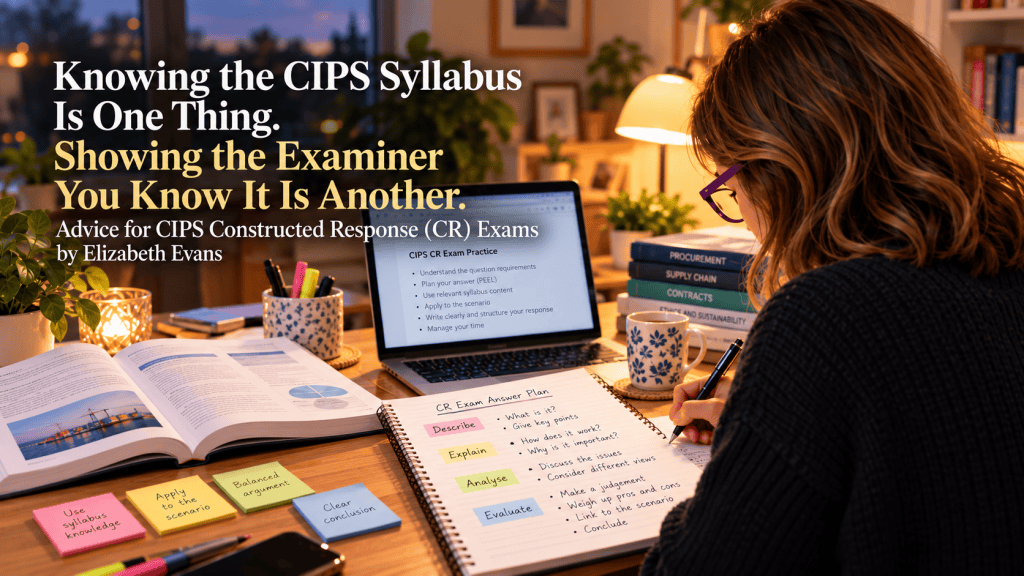
Words such as Describe, Explain, Analyse and Evaluate aren’t just there to make the question sound suitably academic. They tell you what the examiner expects you to do:
- Describe — tell me what its main features are.
- Explain — tell me how or why something happens, or why it matters.
- Analyse — break it down; look at causes, consequences, relationships or implications.
- Evaluate — weigh things up and make a judgement.
So if a question asks you to analyse something and you simply describe it, you may have written several paragraphs of perfectly correct information without actually answering the question.
So how do we avoid that? We stop revising topics in isolation
A lot of revision looks like this:
“Kraljic Matrix. Done.”
“Outsourcing. Done.”
“Porter’s Five Forces. Done.”
And obviously, you do need to know the content.
But once you’ve learnt the theory, one of the most useful things you can do is practise using that same knowledge in different ways.
Take outsourcing. You could ask yourself:
- Describe the advantages of outsourcing.
- Explain why and when an organisation might choose to outsource.
- Analyse the potential impact of outsourcing on supply chain risk.
- Evaluate whether outsourcing would be appropriate for a particular organisation.
Same topic. Very different answers.
That kind of practice forces you to stop thinking:
“What do I know about outsourcing?”
and start thinking:
“What is this question actually asking me to do?”
That shift is really important.
Give me an example
This is one of the easiest ways to improve a CIPS answer. And no, we’re not talking about memorising 400 case studies about Apple and Zara and Toyota. A perfectly sensible hypothetical example can often do the job.
Examples — whether real or made up — do two things. They show that you understand how the theory works in practice, and they make your answer much easier to follow.
If you’ve ever watched one of my video courses, you’ll know I like to relate everything back to my hypothetical cake factory. It turns fairly dull theory into something tangible and shows how it could actually work in practice. That sort of application is particularly useful when you’re answering case-study questions.
Read the actual question. Then read it again.
This sounds ridiculously obvious. But under exam pressure, it is very easy to spot a familiar topic and immediately start writing everything you remember about it.
Before you write, ask yourself:
- What topic is this testing?
- What command word has been used?
- Is there a specific context I need to apply this to?
- How many separate things is the question asking me to cover?
Then keep referring back to the wording of the question as you write.
One very simple check is to stop after each paragraph and ask: Does this paragraph actually help answer the question? If the answer is no, there is a decent chance you’ve wandered into “here is everything I know about this topic” territory…. It’s a dangerous place to go.
Structure helps more than people think
You do not need to produce a literary masterpiece. Nobody is giving you extra marks because your introduction is particularly elegant. A clear, relevant answer is much more useful than an elegant one that doesn’t actually answer the question.
A useful paragraph structure might look something like this:
- Point — make the point you want to discuss.
- Explain — explain what you mean and why it matters.
- Example — give an example where appropriate.
- Link — connect it back to what the question actually asked.
So if you ever find yourself staring at the screen thinking, “I know this, but I don’t know what to write,” remember PEEL.
It gives you a simple framework to get started:
Point. Explain. Example. Link.
Don’t confuse quantity with quality
Writing more does not automatically mean getting more marks. A shorter answer that directly responds to the question can be much stronger than a long answer full of correct information that never quite gets to the point.
The aim isn’t to empty your brain onto the page.
The aim is to show the examiner that you understand the topic and can use that knowledge to answer the question you’ve actually been given.
So when you’re revising, don’t just ask yourself:
“Do I know this topic?”
Ask:
- Could I describe it?
- Could I explain why it matters?
- Could I analyse the implications?
- Could I evaluate whether it would be appropriate in a particular situation?
Because knowing the CIPS syllabus is one thing. Showing the examiner you know it is another.
For more help with planning written answers, explore my CIPS exam technique and revision tips and study articles.
Written by Elizabeth Evans MCIPS. Study Procurement is an independent learning resource and is not affiliated with or endorsed by CIPS.

