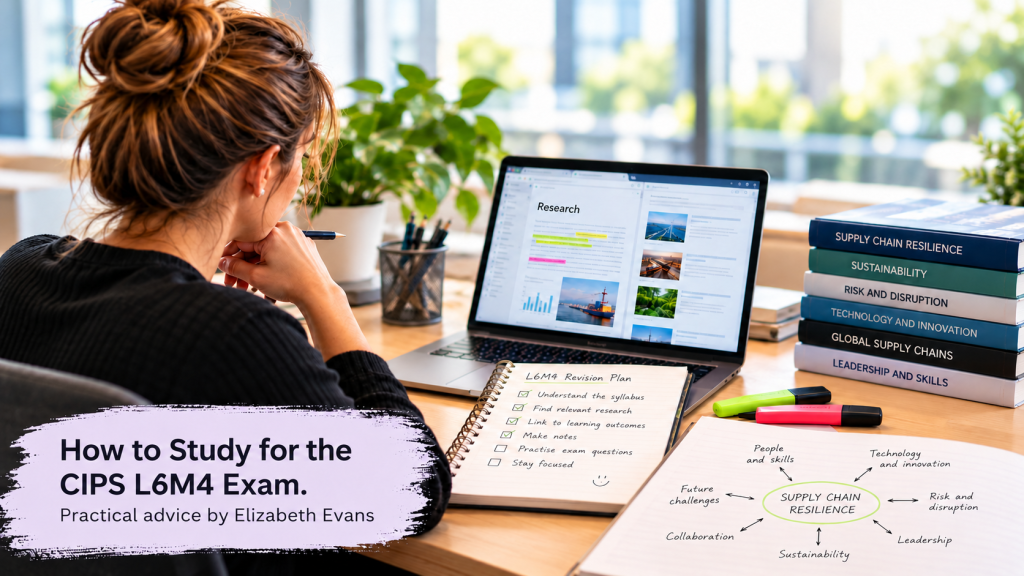
A practical guide to CIPS Level 6 Module 4: Future Strategic Challenges for the Profession, including advice for the November 2026 Supply Chain Resilience theme.
If you’re studying for CIPS L6M4 (Future Strategic Challenges for the Profession), you’ll have realised by now that this module is a bit different from all the others. There’s no textbook telling you exactly what to read.
Instead, CIPS gives you a theme, and you’re expected to go off and research it yourself.
Which sounds quite interesting, doesn’t it?
Until you sit down at your laptop, type your theme into Google, and realise there are approximately 47 million things you could be reading. So where do you start? And, more importantly, how do you know whether you’re researching the right things?
Because with L6M4, you can work incredibly hard, do loads of research, and still get the exam completely wrong.
And I’ve seen that happen.
The Story of Mark (and How Not to Study for L6M4)
When I was studying for my CIPS qualifications, I was doing it alongside a colleague called Mark.
Mark was a few modules ahead of me, so when I was still working my way through Level 5, he was preparing for L6M4. This was back in the days when we actually had to go to an exam centre to sit our exams (we didn’t have the luxury of logging on from home for a remote invigilation) and we were at the same exam centre, sitting different exams.
Mark had been researching his L6M4 theme for weeks. It was something to do with technology in supply chains. And he’d REALLY done his research. He had printed off tonnes of articles about blockchain, the Internet of Things, how technology was being used in logistics and warehouses, and examples of real businesses putting these technologies into practice.
He even understood how some of the actual technology and coding worked (which really impressed me because it’s not something we did in our day jobs). He was prepared. He knew everything about his theme.
He went into that exam feeling confident.
He came out looking considerably less confident.
And when the results arrived, he’d failed.
I remember feeling so disheartened for him because I’d seen how much work he’d put into it.
He’d done everything you would normally expect a good student to do; he’d researched extensively, understood the subject and memorised examples.
I remember him saying to me:
“I just did it all wrong.”
And that’s stuck with me ever since.
Because Mark hadn’t failed through a lack of effort. He’d failed because he hadn’t understood what he was supposed to be preparing for.
He hadn’t even realised there was a syllabus he should have been working from.
He’d prepared for an exam about technology in supply chains… but that wasn’t really what L6M4 was testing.
So, How Should You Actually Study for the CIPS L6M4 Exam?
Here’s the most important thing I can tell you about preparing for L6M4:
You are not being tested on how much information you can memorise about your theme. You need to demonstrate that you can apply your research to the requirements of the L6M4 syllabus.
And that changes how you should approach your revision.
The best way to prepare for L6M4 is to understand the syllabus first, research how your theme relates to the future of procurement, and practise applying that research to exam-style questions.
1. Start with the L6M4 syllabus, NOT the theme
Before you start researching anything, go and find the official CIPS L6M4 syllabus (follow the link and then click ‘download the full syllabus’).
Read the learning outcomes and assessment criteria carefully.
What does CIPS expect you to understand? What kinds of issues are you expected to analyse, evaluate or discuss? Get your head around those first because the syllabus is effectively your roadmap for the exam.
The theme gives you the subject matter to explore, but the syllabus tells you what you need to be able to do with that information.
2. Work out how your theme relates to the syllabus
Once you’ve got a good understanding of the syllabus, THEN start thinking about your theme.
For the November 2026 CIPS L6M4 exam, the theme is Supply Chain Resilience.
Don’t do a Mark. Don’t spend weeks finding examples about supply chain disruptions, natural disasters, pandemics, geopolitical tensions, shipping delays, supplier failures and all the other things that can go horribly wrong in a supply chain.
The title of this module is FUTURE STRATEGIC CHALLENGES FOR THE PROFESSION. It doesn’t really matter what’s happened in the past- we need to know what supply chain resilience looks like IN THE FUTURE.
So rather than just reading everything about supply chain resilience, we need to find articles and papers specifically about supply chain resilience in the future. Trends. Predictions. What people are doing now to prepare for the way the world is changing.
For example, Learning Outcome 1.2 looks at the skills and knowledge required by future strategic procurement leaders. So if we’re researching Supply Chain Resilience, we might investigate what new skills procurement leaders will need to manage disruption, deal with increasingly complex supply chains and make decisions in uncertain situations.
3. Research with a purpose
We need to be picky with what we’re reading. We’re only looking for research that relates both to supply chain resilience AND the syllabus content AND that’s focused on the future.
Narrowing down that scope will help us pick out the useful research that we can use and quote in our exam.
Here’s a little trick. Before you commit to reading a 40-page research paper, skim the abstract, introduction and conclusion first. Also flick through and see if it has any fun graphs or diagrams you can pick out statistics from. Ask yourself: Does this paper actually tell me anything useful about the future of procurement and supply chain resilience? Can I link it to a specific part of the syllabus?
If the answer is no, move on. You don’t need to read everything you find.
(If you’d like help finding the right stuff to read- this is something I can help with – see below)
4. Practise applying your research to exam-style questions
The exam is 2 hours long and consists of 2 questions – one from Learning Outcome 1 and one from Learning Outcome 2. Logically, this means you’ve got an hour per question.
So once you’ve done your reading, try some writing. Spend 10 minutes collecting your thoughts and writing a plan, 40 minutes writing and 10 minutes checking and editing.
For example, using the November 2026 Supply Chain Resilience theme, you could practise questions such as:
1) Evaluate the skills, knowledge and leadership capabilities required by future procurement and supply chain leaders to develop and maintain supply chain resilience. (LO 1.2)
2) Assess the growing importance of cross-functional collaboration and supplier relationships in developing supply chain resilience. (LO 2.2)
These are illustrative practice questions I have invented, not official CIPS exam questions.
L6M4 Revision: The Do’s and Don’ts
- Don’t assume you need an in depth or technical knowledge of your theme
- Don’t focus on past examples of your theme
- Do read the syllabus before starting your research
- Do look at what industry leaders are saying about change and the future
- Do link your research to the learning outcomes
- Do practise some mock questions so you have an idea of how to put your research into an essay
And if you can, DO try to enjoy researching. It’s the only CIPS module that gives you a bit of freedom to explore a topic in more depth and use the more analytical side of your brain.
Is there a course I can take for L6M4? Is there an online tutor for L6M4?
Yes- I made it! It’s me!
I’m Elizabeth Evans, an MCIPS-qualified procurement professional, and I create CIPS revision courses on Udemy.
When I came to study L6M4 myself, and then later when I started creating CIPS revision courses and practice questions on Udemy, I hadn’t forgotten what had happened to Mark. I wanted to create a course that was on-demand (so you can access it whenever is convenient to you and you aren’t restricted to a specific timetable) and guides students through HOW to research.
So my course is essentially this;
- Videos explaining the syllabus- what it is CIPS expect you to know for the exam
- FAQs – all of the questions that me and Mark had- answered in simple English; how many articles do I need to read? What’s the best way to quote an article in the exam? How do I remember all my research if I can’t take my notes into the exam?
- Your Theme explained – I update the course every time a new theme is released
- Reading Pack – I provide you a list of useful papers and articles related to your theme (and that match the syllabus). For November Supply Chain Resilience I’ve got 5 downloadable PDF white papers from brilliant academic sources and links to some shorter articles.
- Activity Pack – for those who want a bit of guidance with their revision I have designed activities and resources to help you organise your revision. Templates for you to add notes to, flash cards you can print out, and a large set of practice questions covering all possible learning outcomes.
The course has recently been updated for the November 2026 L6M4 exam theme: Supply Chain Resilience.
Of course, you don’t need to buy a course to prepare for L6M4. You can absolutely do this independently using the official syllabus and your own research.
But if you want a bit of extra support and guidance, the course is there to give you some structure and help you avoid going down the wrong rabbit holes: https://www.udemy.com/course/cips-l6m4-future-strategic-challenges/?referralCode=D3C0274EB89015D54749
Because nobody wants to spend three weeks learning how blockchain code works only to discover that’s not what they needed to know (Sorry, Mark.)
Final Thoughts: L6M4 Is a Brilliant Module, If You Approach It Properly
In my humble opinion, L6M4 is one of the most interesting and genuinely useful modules in the entire CIPS syllabus. It’s an opportunity to look beyond textbooks and theories and explore the real challenges facing procurement and supply chain professionals.
You get to investigate what’s happening in the world, look at how organisations are responding, challenge different approaches and form your own conclusions.
And those are skills you’ll use long after you’ve finished your CIPS qualifications.
Good luck to everyone sitting this exam! If there’s any Dos and Don’t I have forgotten, or you have any other advice for students taking this exam- please let me know in the comment section below.
Written by Elizabeth Evans MCIPS. Study Procurement is an independent learning resource and is not affiliated with or endorsed by CIPS.

